





We all know that the siren call of the “Skip Intro” button is strong, but some TV shows have opening credits that are so good they’re simply unskippable. A notable subset of this category are shows that change up their intros in interesting ways, either from episode to episode or from season to season. For instance, both Game of Thrones and The Expanse chart the progress made in their fictional worlds in their ever-transforming opening titles, while each season of Outlander employs a new version of the theme song to reflect its changing setting. In that vein, here are six TV shows that have fun switching up their opening titles.
Gravity Falls
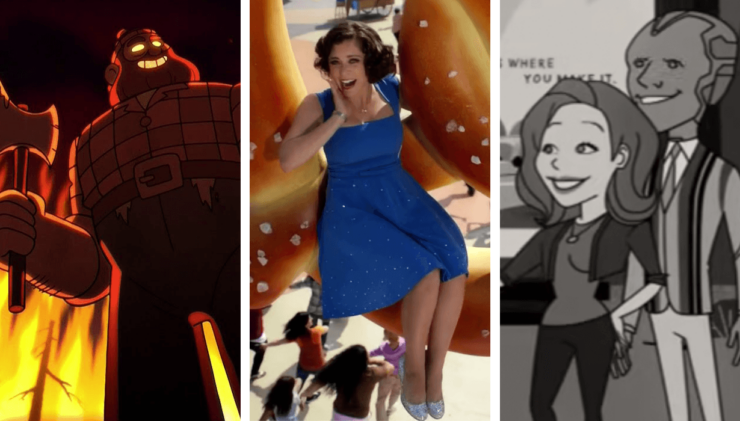
For any eagle-eyed viewers (or maybe “bat-eared” would be more accurate), the catchy intro of Gravity Falls holds a few codes that are needed for cracking cryptograms in the rest of the show. It’s very cool, but these occasionally-changed codes aren’t what I want to talk about, here. That honor goes to the brilliant intro for the series’ grand finale, the three-episode “Weirdmageddon” arc. Spoilers ahead for anyone who hasn’t seen the show (it’s fantastic—go watch it!).
For the first few seconds at the start of each episode, everything seems normal, but then a creepily corrupt rendition of the theme song kicks in and we get a version of the intro with Bill Cipher running the show—his name even replaces Alex Hirsch’s for the “created by” credit. A particular highlight is Bill’s friend 8 Ball taking Dipper’s usual place in the credit sequence—instead of coming across the usual skeleton of a horned monster, he sees Dipper’s skeleton. Hirsch also knew that fans of the show were well-versed in seeking out clues by this point, so Bill (voiced by Hirsch) can be heard saying “I’m watching you nerds” if the intro is played in reverse.
A special shout-out also has to go to the fan-made Gravity Paws intro that aired during Animal Planet’s Puppy Bowl XII to celebrate the show’s finale. It’s a recreation of the intro using adorable real-life dogs, and it’s a thing of canine beauty.
The X-Files
The opening credits of The X-Files almost always ended with the tagline “The Truth Is Out There,” but there are a handful of episodes that switched it up. The first time it was changed was for the last episode of the first season, “The Erlenmeyer Flask,” which instead used the chilling phrase “Trust No One.” The rarity of the tagline being changed made it all the more exciting when something different did flash up on screen, such as “I Want to Believe, I Want to Lie” and “erehT tuO sI hturT ehT” (read it backwards). A complete list of alternate taglines can be found here.
Cast changes throughout the eleven seasons of The X-Files also led to actors being subbed in and out of the credits and occasionally the imagery was updated. None of these changes are particularly interesting (though if you’re so inclined, you can watch them all here), aside from the intro that’s played halfway through “The Lost Art of Forehead Sweat” in season eleven. This episode is about the Mandela Effect (involving collective false memories) and alleges that there was actually a third agent working alongside Mulder and Scully this whole time: Reggie Something (played by Brian Huskey). When this is revealed, a fun version of the intro , now featuring Reggie, is played.
WandaVision
Given that each episode of WandaVision is a homage to a different decade of TV sitcoms, it’s only fitting that the episodes would have different theme songs in a matching style, all of which have been compiled here. The songs were composed by Robert Lopez and Kristen Anderson-Lopez, who are best-known for writing the music for Disney’s Frozen. In an interview with Entertainment Weekly, Anderson-Lopez said they made sure they “weren’t parodying any one show, that the songs we were writing would evoke all of the iconic songs from an entire decade and be their own thing.”
Their influences are pretty easy to spot. Episode two, “Don’t Touch That Dial,” has an animated opening that is reminiscent of Bewitched, along with a catchy ’60s-style jingle (“WandaVision! Wa-WandaVision!”—I’m sorry if that’s now stuck in your head). Episode five, “On a Very Special Episode…,” features a saccharine ’80s ballad, in the vein of Family Ties and Growing Pains, played over images of the cast’s family portrait being painted, inspired by the former, and pictures of the characters growing up, inspired by the latter.
BoJack Horseman
Anyone who has clicked “Skip Intro” on BoJack Horseman has missed out on a ton of fun details. The title sequence is locked onto BoJack’s blank face as he goes about his day, disconnected from what’s going on around him. But a few episodes in, details in the background—and later the background setting itself—start to change, evolving to keep in sync with the continuity of the show.
This first happens after episode three, where the leg of BoJack’s bed is broken and his ottoman is set on fire, with the damage from both visible in the opening credits of episode four. The amount of detail put into these changes in the background is impressive. There are also a couple of episodes with completely different intros: season two’s “Escape from L.A.” has a sitcom parody song called “Kyle and the Kids” and season five’s “The Showstopper” plays the title sequence for the in-world show Philbert.
If you’ve already seen BoJack Horseman and want a spoiler-filled recap of the changes, then check out this video. If you’ve not seen the show, enjoy searching the background to catch sight of different objects and characters coming and going as you catch up!
Community
The title sequence for most Community episodes is the same—“At Least It Was Here” by The 88 plays over an origami-style paper fortune teller decorated with drawings and the cast’s names. There are a few opening credits that slightly diverge from the basic format in order to reflect the content of the episodes: in season two’s “Advanced Dungeons & Dragons” the drawings are switched out for fantasy objects and characters, such as a wizard and a phoenix, while Halloween episodes feature appropriately spooky images, such as a zombie hand and a mummy.
But there are also a handful of intros that are totally different. It’s hard to pick favorites from this very fun bunch, but a few of mine include “Abed’s Uncontrollable Christmas” with its stop-motion animation, “Digital Estate Planning” with its 8-bit video game graphics, and “Basic Lupine Urology,” which is a parody of Law & Order. All of these delightfully creative variations can be seen here.
Crazy Ex-Girlfriend
The four seasons of Crazy Ex-Girlfriend all feature different opening theme songs, but the song isn’t updated just for the hell of it. Each song is a story that main character Rebecca (Rachel Bloom) is telling herself, and so, as she changes and grows over the course of the show, the theme song also changes. Season one’s intro is Rebecca singing about moving to California to pursue her one-time crush from summer camp, with the animation indicating that she’s not living in reality. The sun singing “She’s so broken inside!” is a definite highlight (and is voiced by Adam Schlesinger from Fountains of Wayne, who served as the show’s executive music producer, eventually co-writing over 150 songs with Bloom and others).
Season two’s song sees Rebecca performing with showgirls in a Busby Berkeley-esque musical number as she fully indulges her impulses, but there’s a hint of unease in the lingering shot on her face at the end. Season three’s intro manages to analyze popular culture’s conflicting uses of the word “crazy” in just a few lines, with Rebecca taking on different musical roles, from a Carrie Underwood-esque country singer to an Eminem-esque rapper, as she tries to sort through the mixed messages.
Season four’s song feels a little different from the others. It’s shot in the style of an upbeat sitcom, but Rebecca herself is no longer singing and performing, indicating that she’s moving past this coping mechanism. It still retains its comedic flair though, with the “other Rebecca” at the end saying something different each time—my personal favorite being “I miss the season one theme song.”
***
Of course, I haven’t covered every great TV show that switches up its opening sequence in the short list above, so drop your favorite examples in the comments below!
Lorna Wallace has a PhD in English Literature and is a lover of all things science fiction and horror. She lives in Scotland with her rescue greyhound, Misty.

The greatest thing about all the WandaVision credits and songs is that they also all have the same little motif buried in; one that is actually pretty similar to the Dies Irae which gives it that touch of ominous-ness.
(And funnily enough, the Dies Irae is also used as a motif in Frozen II for the calling song…I have a huge randomized playlist of various music and soundtracks and it’s quite fun when they show up together you can really see how they are from the same creative team.)
The anime “School-Live!”, about which very little can be said without spoilers, starts with a typical peppy Cute Girls Doing Cute Things anime intro that gradually shifts and changes as the audience learns more about what’s going on. Highly recommend it, and highly recommend going in blind if you can.
Babylon 5. Each new season’s opening credits were totally different from all the others, including narration and the cast-rotations:
https://www.youtube.com/watch?v=7vIVFgXaxsU
The X-Files revival had its share of disappointing episodes, but “The Lost Art of Forehead Sweat” was not among them. It’s a superb (and absurd) outing, and for me serves as the true finale for the series.
Stargate SG-1 must have changed up its opening for special events but I don’t remember for sure.
Star Trek Lower Decks has the ‘fight’ scene in each Season which is adding more and more types of ships/entities to the fight each Season.
A Couple of other Star Trek Series have had special Title Sequences – Enterprise had an entire Mirror Universe Title for their Two-Parter in Season 4, and Strange New Worlds has had an Acapella style choir singing their title music for the musical episode, and an animated title for the cross-over episode with Lower Decks (which is Animated).
The opening credits for Buffy the Vampire Slayer for the musical episode, “Once More With Feeling,” were done in a unique, retro-1960’s sitcom style.
Ummm…”The Simpsons”????
Good Omens.
Buffy changing its credits every season was great. (And sometimes during a season when an actor left or joined.)
Fringe is an excellent example of this! Categorizing alternate dimensions by color/topic and even the handful of episodes that took place in the past had 1980s-themed intros.
The Netflix She-Ra revival had a lot of fun changes to the opening as the plot developed and characters’ status and allegiances changed, especially in the final season. I wrote a blog post about them when I noticed they were happening.
The Wire had a different person or group sing the theme song each season. Psych occasionally has different versions of its theme song such as one in Spanish when he’s on a telenovela and another in Hindi for the Bollywood episode.
The Wire had a different person or group sing the theme song each season.
And a different title sequence too – consisting of some generic clips that never actually appeared in the show (drugs, oscilloscope traces etc), some clips from that season, plus a few from all the previous seasons.
Some genius put together an intro for Game of Thrones in the style of The Wire https://youtu.be/7oyJXikl2L4
“Psych” had fun changing the style of their intro a number of times (Christmas, Bollywood, Spanish, doo-wop, etc.), but the crown jewel was the “Twin Peaks” parody. Purely bizarre!
Babylon 5 did this perfectly, as someone else commented. And Fringe changed things up in some subtle and not-so-subtle ways throughout its run.
Two episodes of The Prisoner had unique opening credits. “Living in Harmony” reset the series as a Western, and “Fall Out,” the final episode, which was the only one to begin with a recap of the previous episode.
The Gintama anime LOVES to do this with both its opening and its ending songs. Sometimes it’s just something small, sometimes it’s…a little less so. (“Don’t blame me. There’s bound to be a mishap when you do the same thing 23 times in a row.”)
One of my favorite TV shows ever, Agents of S.H.I.E.L.D, does a credits swap a few times. Well not the credits themselves, but the opening logo. In the first few seasons the logo is the standard SHIELD eagle badge with one notable exception – the landmark episode Turn, Turn, Turn, which revealed the extent of HYDRA’s infiltration of SHIELD, closed with an ominous HYDRA logo instead of the SHIELD badge. Season 4 also employed an alternate logo: each of the three arcs employed a different variation. The first arc, the Ghost Rider arc, used a burning variation to reference the titular Ghost Rider. The second arc, the LMD arc (killer robots perfectly mimicking the main characters) used a robotically assembled badge. And finally and most dramatically, for the Framework arc (in which Our Heroes are imprisoned in what amounts to an alternate universe where HYDRA rules the world) the logo is a HYDRA badge, and the show is introduced as “Agents of HYDRA.” Creepy. The best part is for the season finale, which starts with Our Heroes returning to Earth, returns to the regular SHIELD badge (with a heroic intance of the main theme to boot), which is certainly a fist pumping moment after six episodes in a hopeless, dystopian mirror universe.
‘Person of Interest’ does this, particularly in the latter seasons as the show starts putting more overt sci-fi into its espionage/thriller mix.
I thought the show was generally pretty terrible, but credit where credit is due (especially when they’re opening credits): Enterprise changing their opening credits for the Mirror Universe episode “In A Mirror, Darkly” from the usual optimistic “history of flight” montage to a darker “history of aggression” montage was super clever.
I suppose the crazy obvious answer here of Game of Thrones was too much to include? While us readers didn’t need the context for locations I’m told it helped a lot of new viewers to the show.
It was rare, but the most memorable ‘special event’ change has to be for the 200th episode (the second episode to feature the Wormhole Extreme! parody). Since the entire episode was a send-up not only of Stargate but other sci-fi shows and tropes, they even made fun of the 2000’s-era trend to have an extremely short opening title sequence when Stargate normally had the more traditional long sequence: Stargate SG1 200 – Opening sequence.
Banshee, Ozark, Weeds
Black Adder!
The Afterparty on Apple TV has a different intro for each episode, usually based on the character-in-focus for that episode.
Outlander has a new version of the theme song for each season and the opening for each episode is customized for that episode.
Brain Dead, a satirical SF+politics summer series in 2016, had an intro with a folk song recap of the previous episodes, different each week, until the story got so complicated, the song recap sort of self-destructed.
Would I be outing myself as a parent if I mention Bluey? The family playing musical statues is always fun to watch, of course, but notably the episode called “Bingo” has Bingo winning the game and therefore the name of the show. “This episode of Bingo is called Bingo.”
At the end of “Anasazi” (the infamous “Mulder in the Boxcar” season finale,) the closing tagline was Éí ‘Aaníígóó ‘Áhoot’é, meaning “The Truth Is Out There” in Navajo.
I think She-Hulk changed up the images over the closing credits each week. Loki might have?
Star Trek: Enterprise had a *very* different introduction for the episodes in the Mirror Universe (all hail Empress Hoshi!).
I’m surprised nobody mentioned Heartbeat, which changed the cast minivids, and the backgrounds, throughout the later seasons.
Only Murders in the Building inserts subtle plot points from the upcoming episode into its opening credits. A recent episode featured a sandbag falling next to the main characters’ silhouettes toward the end.
A couple of people mentioned specific episodes of The Prisoner, but I’ve always considered the “I am Number Two. …” section – which is different for each episode – to be part of the opening credits.
The thematically appropriate instrumental cover songs in the credits for Westworld season one were probably my favorite part of that series <shrug>. I haven’t watched season two, so I don’t know if that continued.